Edward Newman: When Entomology Meets Poetry

On this day page marker white background
This botanical history post was featured on The Daily Gardener podcast:

Click here to see the complete show notes for this episode.

June 12, 1863

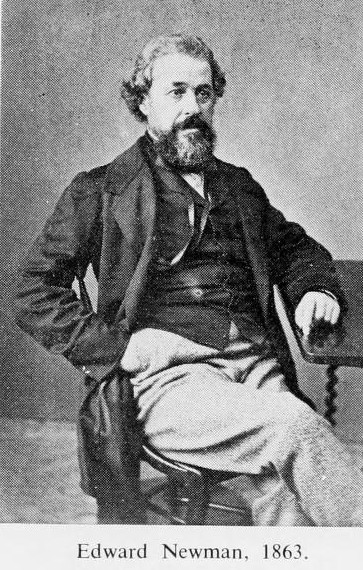
Dear readers of the soil and bloom, on this day we mark the anniversary of Edward Newman's departure from this earthly garden.

The notable English entomologist, botanist, and writer has left us with a legacy as varied and intricate as nature itself.

Newman, with his meticulous eye and steady hand, bestowed upon us An Illustrated Natural History of the British Moths in 1869, a work that continues to illuminate the mysterious world of these nocturnal creatures.

One cannot help but wonder if he spent his evenings chasing these elusive beings through moonlit gardens, net in hand, while the rest of London slept soundly in their beds.

But our dear Mr. Newman was not merely content with scientific observation. No, he harbored poetic sensibilities that flowered alongside his botanical pursuits.

His verses reveal a man who found the divine in both scientific precision and artistic expression—a rare combination indeed in an age where men often chose sides between art and science as if they were warring nations rather than complementary realms.

Just as the butterfly, child of an hour,
Flutters about in the light of the sun,
Wandering wayward from flower to flower,
Sipping the honey from all, one by one;
So does the fanciful verse I've created
Love amongst the experts in Science to roam,
Drinking their spirit without being sated,
Bringing the sweets of their intellect home.

Is it not delicious, this metaphor he crafts?

The poet as butterfly, the scientist as flower—each providing sustenance for the other.

One might suggest that Newman himself embodied this symbiosis, his scientific mind and poetic heart working in tandem like the most harmonious of garden companions.

In our own gardens, we might do well to remember Newman's example.

Science tells us when to prune, what soil pH to maintain, and how much water our plants require.

But it is the poetic heart that reminds us to pause amidst our labors, to notice the delicate curve of a petal or the industrious journey of a beetle across a leaf.

Newman's work reminds us that the garden is both laboratory and muse, a place where observation and imagination intertwine like the most determined of climbing roses. His dual passions—entomology and poetry—suggest that perhaps the truest understanding of nature comes not from categorization alone, but from a willingness to both study and celebrate its mysteries.

As you tend to your September gardens, dear readers, I encourage you to channel a bit of Newman's spirit.

Observe with the precision of a scientist, yes, but allow yourself the occasional flight of fancy.

After all, what is a garden if not nature's poetry made visible?

Edward Newman
Edward Newman

Leave a Comment